A crate reaches the preparation area with a courier note, a printed loan record, two condition-report copies, and a packing list. One sheet says “received,” another has initials with no date, and nobody can tell whether the condition review happened before or after unpacking. The object is protected; the paperwork is not telling a coherent story.
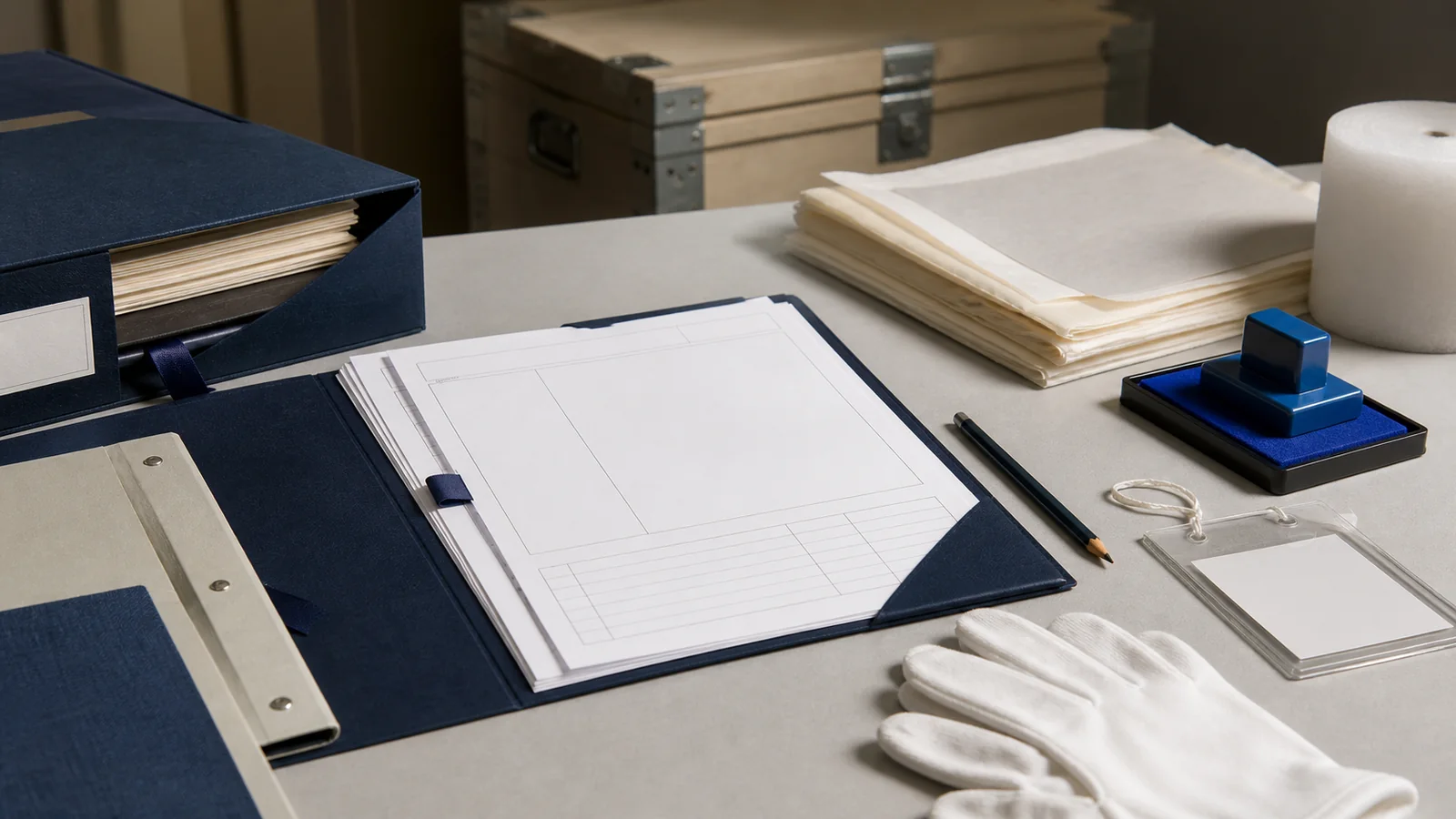
Museum loan paperwork stamps can make document states easier to recognize during outgoing loans, incoming loans, exhibition changes, and returns. The critical boundary is simple: the stamp belongs on approved paperwork, tags, folders, or disposable transport records, never on a collection object. Any marking material used near collections should follow the institution's conservation and handling procedures.
This article focuses on document workflow, not legal title, insurance, customs, valuation, conservation treatment, or loan approval. Those decisions require the museum's authorized records and qualified specialists. A visual mark can route a form; it cannot replace professional judgment.
Before designing any stamp, define where it may be applied. “Museum loan stamp” can be misunderstood as a mark for the object itself, especially when staff are accustomed to library ownership marks or accession labels.
Create an explicit allowed-use list, such as:
- loan file covers;
- internal routing sheets;
- condition-report control copies;
- packing lists;
- crate or transport document sleeves;
- temporary work cards approved by the institution;
- scanned document overlays when the system permits them.
Then create an equally clear prohibited-use list. It should include collection objects and any surface, mount, frame, housing, historic label, or packaging component that the institution protects as part of the collection or its documentation. The exact boundary varies, so the local conservation and collections teams must approve it.
If a visual identifier must travel with an object, use the institution's approved tag, sleeve, container, or record method. Do not improvise adhesive labels or direct impressions because a stamp layout looks convenient.
A useful mark represents a decision that has actually occurred. Avoid broad words such as DONE or APPROVED unless the institution defines exactly what they cover.
An outgoing-loan workflow may include:
- request logged;
- internal review initiated;
- object and record matched;
- condition documentation prepared;
- packing plan confirmed;
- dispatch documentation assembled;
- handoff recorded;
- loan monitoring active;
- return expected;
- return condition review completed;
- file reconciled and closed.
An incoming loan has a different sequence. The borrowing museum may record arrival, controlled holding, unpacking authorization, incoming condition review, installation readiness, deinstallation, repacking, dispatch, and file closeout.
Do not force both paths into one giant stamp. Create focused marks for points where a document changes owner or status. ARRIVAL RECORDED, CONDITION REVIEW PENDING, and RETURN FILE RECONCILED carry clearer instructions than a universal PROCESSED box.
The stamp should help staff locate the authoritative record. It should not reproduce every loan detail.
A compact field set may include:
- loan or case reference;
- object or group reference as permitted by policy;
- document state;
- date and time when operationally necessary;
- staff initials or controlled identifier;
- related report, crate, courier, or exception reference;
- next owner or review point.
Avoid placing lender contact details, values, insurance information, transport security details, or other sensitive content in a reusable mark. Keep those data in the approved system and controlled documents.
For a library-style visual structure, the can provide a starting shape, but the wording and use rules must clearly distinguish museum loan paperwork from ownership marking. A rectangular fielded layout may be more practical than a circular seal when staff need to write a case number and date.
Leave enough space for the longest real reference. A field tested only with L-24 may fail when the institution uses year, department, partner, and sequence codes. Shortening identifiers on the fly breaks the connection the stamp is meant to preserve.
The condition-report process deserves precise language. A stamp can indicate that a report was received, a review was requested, a comparison was completed, or an exception was routed. It should not compress the condition assessment into a vague “good” or “damaged” label.
Useful document states might include:
- condition report attached;
- incoming comparison pending;
- review completed — see report;
- change noted — exception reference attached;
- photography reference logged;
- conservator review requested.
The detailed observation belongs in the approved condition record. The mark should point to that record and identify the workflow state. This prevents a brief label from being treated as the professional assessment itself.
Use neutral language. CHANGE NOTED describes a documentation event; it does not assign cause or responsibility. REVIEW REQUESTED routes the file without pretending that a conclusion already exists.
If multiple objects share a loan, decide whether the mark applies to the whole group or one item. State the scope. A group-level “condition review complete” can be misleading when one component remains pending.
Packing records and custody records answer related but different questions. A packing list shows what should be in a crate or case and how components are organized. A custody or handoff record identifies when responsibility moved according to the institution's process.
A packing-stage mark can include:
- packing plan reference;
- crate or container ID;
- item count or list reference;
- packed-by identifier;
- check or review identifier;
- date and next destination.
A handoff mark may instead prioritize:
- loan reference;
- container ID;
- dispatch or receipt time;
- handing and receiving identifiers;
- courier or transport record reference;
- exception notation.
Do not let PACKED imply DISPATCHED, and do not let RECEIVED imply that unpacking or condition review is complete. Each mark should describe one completed event.
For object movement, follow approved handling, security, transport, and documentation procedures. The stamp is a small interface to those systems, not a custody guarantee.
Loan paperwork often gathers signatures, notes, barcodes, photographs, and copied correspondence. A stamp must remain noticeable without covering existing evidence.
Use three visual levels:
- a strong status phrase;
- a medium-weight loan or document reference;
- smaller fields for date, initials, and next action.
Keep the border restrained. Heavy decorative elements can resemble an institutional seal and may imply authority beyond the mark's actual purpose. Plain typography and a clear rectangular field often make a better operational tool.
Test the design on a realistic page with existing marks. Check an original print, a grayscale copy, and a scan. If the status disappears after scanning or the handwriting merges with the border, simplify it.
Placement rules matter as much as artwork. Define a standard area on each document type so staff can find the latest state quickly. If several stamps may appear, use a chronological panel or consistent left-to-right sequence.
Loan work does not always follow the planned sequence. The paperwork should reveal the exception without encouraging staff to solve it through improvised wording.
Reference mismatch
Stop the normal routing and use the institution's discrepancy process. Record the identifiers that were present without inventing a replacement.
Document copy missing
Mark the file as incomplete and name the owner responsible for locating or recreating the approved copy. Do not use a completed-state stamp on the remaining sheets.
Arrival before authorized unpacking
Record arrival according to procedure, keep unpacking status separate, and route the file to the appropriate owner. RECEIVED is not UNPACKED.
Condition concern during review
Use a neutral exception state, connect it to the detailed record, and follow the museum's escalation and conservation process.
Multi-object loan partially returned
Identify the returned subset and leave the overall loan state open until the approved reconciliation is complete.
Every exception mark needs a next owner. PENDING without a person, team, or review point does not protect the workflow; it merely postpones the same question.
Loan terms, forms, departments, and system fields can change. A stamp file copied into personal folders can remain in use long after the official form has moved on.
Store one canonical source for each mark. Give the design a version or effective date in the file record, even if that metadata does not appear in the visible impression. Record who approved the wording and which document types may use it.
When a field or state changes, retire the old source and notify the teams that apply or interpret it. Remove outdated physical stamps from active work areas where practical. A small sample page showing current marks can help temporary staff, couriers working under supervision, and colleagues from other departments understand the vocabulary.
The offers a useful parallel for separating ownership, processing, and withdrawal decisions. Museum loan paperwork needs the same clarity, with the additional rule that a reusable operational mark must never drift onto an object.
Use a closed or training file that accurately represents the paperwork without exposing sensitive data. Walk the documents through both outgoing and return sequences.
Ask participants to locate:
- the current state;
- the authoritative loan reference;
- the latest condition-document step;
- the container or packing reference;
- the next owner;
- any unresolved exception.
Then swap participants. Someone who did not apply the marks should interpret them. This reveals whether meaning depends on the original handler's memory.
Check that exactly one mark represents each state and that chronology remains clear when the file is copied or scanned. If staff need a legend every time, the status phrases may be too abbreviated.
Related design approaches are collected in the , but the institution's collections, conservation, registrar, security, and records procedures must determine the final wording and use.
Can a museum loan stamp be applied to an object?
This guide does not recommend it. Restrict the mark to approved paperwork, tags, folders, sleeves, or containers, and follow the institution's conservation and handling rules.
Should a condition result appear in the stamp?
Use the mark to point to the detailed condition record and show its workflow state. Avoid reducing a professional assessment to a broad label.
Is one stamp enough for outgoing and incoming loans?
Usually not. The workflows contain different decisions, and focused marks make the next action easier to understand.
What is the most important reference field?
Use the identifier that reliably connects the marked document to the authoritative loan record. Preserve its complete approved format.
Does a stamped handoff prove legal custody?
No. It records a workflow event within the museum's process but does not by itself establish legal title, liability, insurance coverage, or custody.
Museum loan paperwork stamps should make document states visible while respecting the boundary around collection objects. Define allowed surfaces, split broad processes into real decisions, connect every mark to the authoritative loan record, and keep condition, packing, and handoff meanings separate. Give exceptions an owner and retire obsolete designs. The result is not a substitute for registrar, conservation, security, or legal records; it is a clearer route through them.
