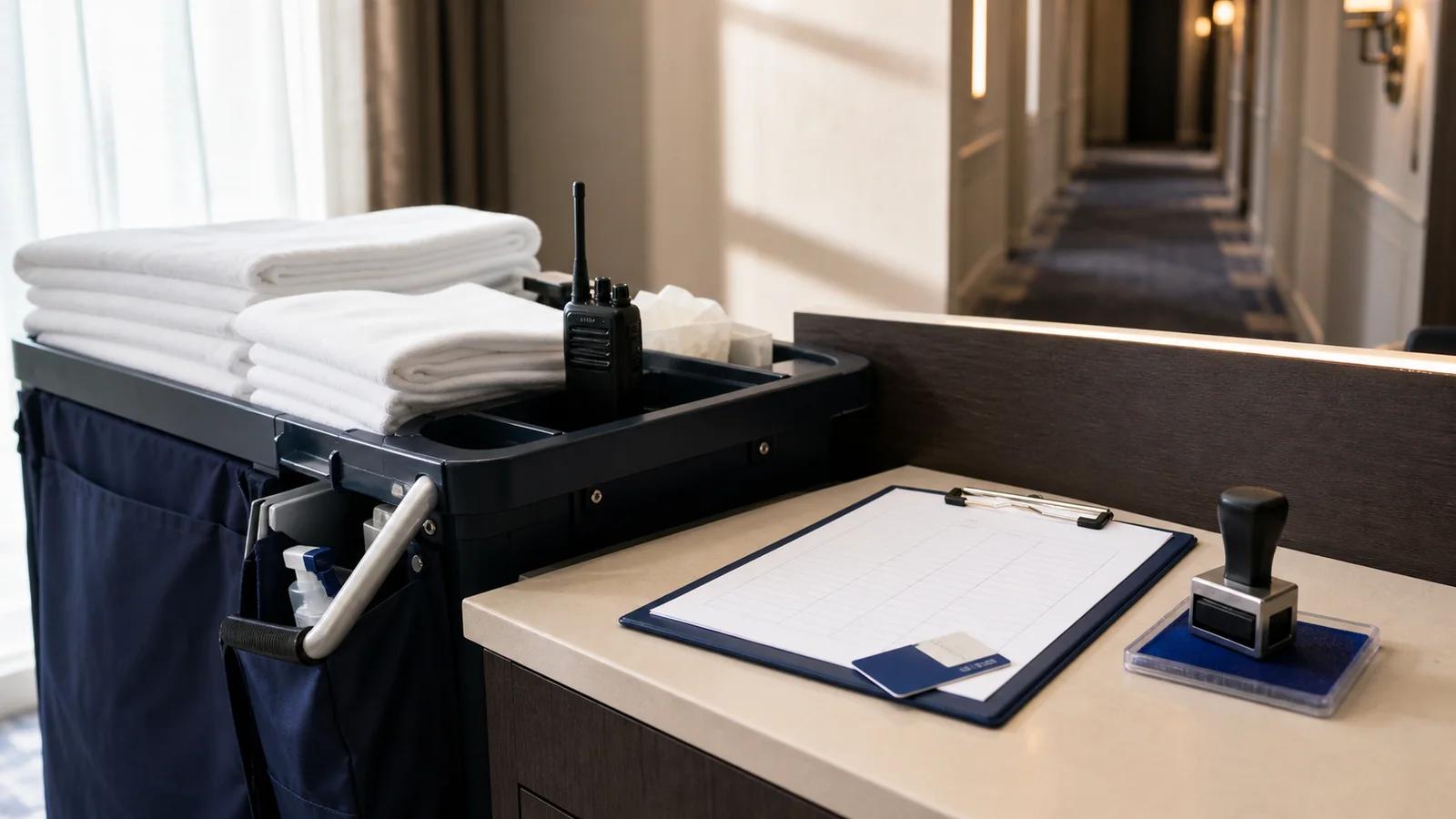
At 2:40 p.m., the housekeeping sheet shows room 614 as cleaned. The front-desk note says it is waiting for inspection. Maintenance still has an open air-conditioning request, and the arriving guest is already in the lobby. Everyone has a status, but nobody has the same one.
Hotel room-status stamps can help when paper lists, printed work orders, inspection sheets, or temporary handoff documents still move between teams. Their job is to make a state visible and identify the next owner. They should never compete with the property's approved management system or turn a quick visual mark into an unofficial source of truth.
The useful question is not “Which stamp should we add?” It is “Which room decision becomes unclear when a shift changes?” Once that decision is defined, a compact mark can support the handoff without filling the page with another layer of hotel jargon.
A room can appear delayed for several different reasons. Cleaning may be unfinished. Cleaning may be complete but inspection pending. A maintenance issue may block release. A supervisor may need to confirm an exception. The room may be ready while the paper list remains outdated.
Follow one room from departure to the next arrival and record every state change:
- departure is confirmed;
- room enters cleaning queue;
- housekeeping work begins;
- cleaning is completed;
- inspection or supervisor check occurs when required;
- maintenance exceptions are opened and resolved;
- the approved system is updated;
- front desk receives the release signal.
Mark the places where a person hands responsibility to another person or team. Those are the moments a status stamp can clarify. If the stamp is added at a step with no handoff, it may become decoration rather than information.
Also note which record is authoritative. A printed room list may be convenient on a floor, but if the property-management system controls room availability, the paper mark must feed into that system through a named action. Otherwise the teams will maintain two competing versions of reality.
Hotels often accumulate near-synonyms: clean, cleaned, ready, checked, inspected, released, cleared, available. Staff may understand them during a calm shift, then interpret them differently during a rush.
Use the fewest states that represent real decisions. A workable example could be:
CLEANING— assigned work is in progress;CLEANED— housekeeping task is complete, but release may still be pending;INSPECTION— a defined check is required or underway;MAINTENANCE HOLD— a linked issue blocks normal release;READY TO UPDATE— required floor-side steps are complete and the approved system needs an update;EXCEPTION REVIEW— the room does not fit the normal sequence.
These labels are examples, not a universal hotel standard. The property should use terms that match its approved procedures and system fields. Each term needs a one-sentence definition, a person allowed to apply it, and a clear next step.
Do not use color alone. A red or green impression may be helpful, but photocopies, low-ink prints, color-vision differences, and digital scans can remove that cue. The words must remain understandable in monochrome.
A status becomes reliable when everyone knows who can apply it and who must act next. Without ownership, stamps can become requests disguised as completed decisions.
For each status, write a simple handoff rule:
| Status | Applied by | Meaning | Next owner |
|---|---|---|---|
| CLEANED | Assigned housekeeper | Defined cleaning task completed | Inspector or supervisor |
| INSPECTION | Supervisor | Check started or required | Named inspector |
| MAINTENANCE HOLD | Authorized team member | Linked maintenance issue blocks release | Maintenance lead |
| READY TO UPDATE | Authorized reviewer | Floor-side steps complete | Front desk or system owner |
The table belongs in the procedure, not inside the stamp. The mark needs only the state, room reference, time or date when useful, initials, and an exception reference. Trying to print every rule into the design will make it unreadable.
Ownership also prevents self-approval where the workflow requires separation. If one person may clean and release a room, say so. If a second check is required for certain rooms or exceptions, make that path explicit rather than relying on staff memory.
A room-status stamp will often be viewed on a clipboard, trolley, desk, or scanned page. The reader should understand the state before studying the smaller fields.
Start with a bold text label. An editable provides a useful foundation because it keeps the main word visually dominant. Add a compact supporting row such as:
ROOM ____ TIME ____ INITIALS ____ REF ____
Do not repeat details already printed on the sheet. If the room number appears at the left of each row, the stamp may need only state, time, and initials. If a maintenance ticket is the important connection, give the reference field more space.
Test the longest room identifier used by the property, including building, wing, suite, or connected-room notation. A sample that fits 614 may fail when staff need E-1208A or a pair of adjoining rooms.
Keep the footprint away from guest names, rates, payment details, signatures, and other sensitive or controlled fields. A room-status mark should expose the minimum information needed for the operational handoff.
“Reserved,” “occupied,” and “ready” describe different dimensions. A room can be reserved for a guest but not ready for release. It can be physically clean but blocked by a maintenance exception. It can be ready in the room but not updated in the system.
Avoid using one stamp to collapse those states. The guide to explains why a temporary hold needs an owner and release point. Apply the same discipline here: a maintenance hold should identify the linked issue and the team responsible for clearing it.
Do not let READY imply that every commercial, guest-service, safety, or system decision has been completed. Define precisely what the room-side mark means. A property might use READY FOR SYSTEM UPDATE to show that front desk still has a required action.
If staff need several dimensions on one page, use separate columns or clearly distinct marks. A room number followed by reservation state, housekeeping state, and maintenance state is easier to interpret than a single improvised note.
Housekeeping may notice a problem but may not be responsible for diagnosing or repairing it. The status workflow should help them report and route the observation without encouraging unsupported conclusions.
A compact exception mark can include:
- room reference;
- observed issue category;
- time reported;
- linked maintenance reference;
- reporting initials;
- current release status.
Use factual language such as lamp not operating, water observed near sink, or temperature concern reported according to the property's approved method. Avoid writing a technical cause when no qualified assessment has occurred.
Once maintenance completes its work, decide who returns the room to the release sequence. REPAIR COMPLETE may still require housekeeping attention or supervisor review. The procedure should state the next state rather than leaving the paper in a maintenance tray.
For urgent or safety-related situations, follow the property's established response. A stamp is a documentation aid after the appropriate action begins, not an emergency instruction.
A good shift handoff does not require the incoming team to reread every completed room. It makes unresolved work easy to find.
At shift change, group or flag records in three practical sets:
- completed and updated;
- active work with a named owner;
- exception requiring review or escalation.
For every unresolved room, the incoming team should be able to see the latest state, timestamp, initials, linked reference, and next owner. A note such as waiting is not enough. Waiting for what, and who acts when the condition changes?
Use one cutoff rule. For example, the outgoing supervisor may review all paper statuses before handoff and confirm that each one matches the approved system. The property can define a different process, but someone must own reconciliation.
Retain or dispose of completed sheets according to the property's information and records policy. Do not keep informal room-status pages indefinitely simply because nobody decided when they stop being useful.
Paper can be fast on a floor where staff carry clipboards or trolleys. A digital system is usually better at presenting the current state across departments. The workflow should make the transition explicit.
One pattern is:
- authorized staff apply the paper status at the room-side step;
- the status includes time and initials;
- the system owner updates the approved platform;
- the paper row receives a small confirmation or is moved to completed;
- discrepancies enter the exception path.
Avoid asking two teams to update the same state independently. If housekeeping and front desk can both release a room without coordination, the stamp will not fix the ownership problem.
The offers related operational layouts, but the local implementation should use only the states and fields the property has approved.
Run the proposed stamps through realistic handoffs on sample sheets. Include ordinary and awkward cases:
- cleaning completes with no exception;
- inspection finds a small issue that housekeeping can correct;
- maintenance work spans two shifts;
- the room number is copied incorrectly;
- the paper says ready but the system still shows a hold;
- a connected room has different states on each side;
- a status impression is partial or hard to read.
Ask each participant what the mark means and what they would do next. If answers differ, revise the definition or field label before changing the artwork. A beautiful stamp cannot compensate for ambiguous vocabulary.
Pilot on one floor or team. Collect examples of missing fields, duplicate statuses, and unclear handoffs. Retire superseded files and label the current version so old marks do not reappear from a shared folder.
Should a hotel use one stamp for every room state?
Usually no. A small set of focused states is clearer than one large stamp with many checkboxes. Use only states tied to real decisions and owners.
Can a paper status replace the property-management system?
No. It can support floor-side work and handoff, but the approved system and property procedure should define the authoritative room state.
What fields belong on a maintenance hold mark?
Use the room reference, time, initials, linked issue reference, and next owner. Keep technical diagnosis in the maintenance record.
Is color enough to distinguish clean and blocked rooms?
No. Use explicit words and stable placement so the status survives grayscale printing, scanning, and imperfect impressions.
How should old room-status stamp files be handled?
Store one current source, label its version, and retire superseded files through the property's normal document-control process.
Hotel room-status stamps succeed when they reduce interpretation at the exact moment responsibility changes. Define a small vocabulary, give every state one owner, keep reservation, cleaning, inspection, and maintenance decisions separate, and connect the paper cue to a named system update. Test the awkward cases before rollout. The result should be a cleaner handoff, not another unofficial room list competing for attention.
