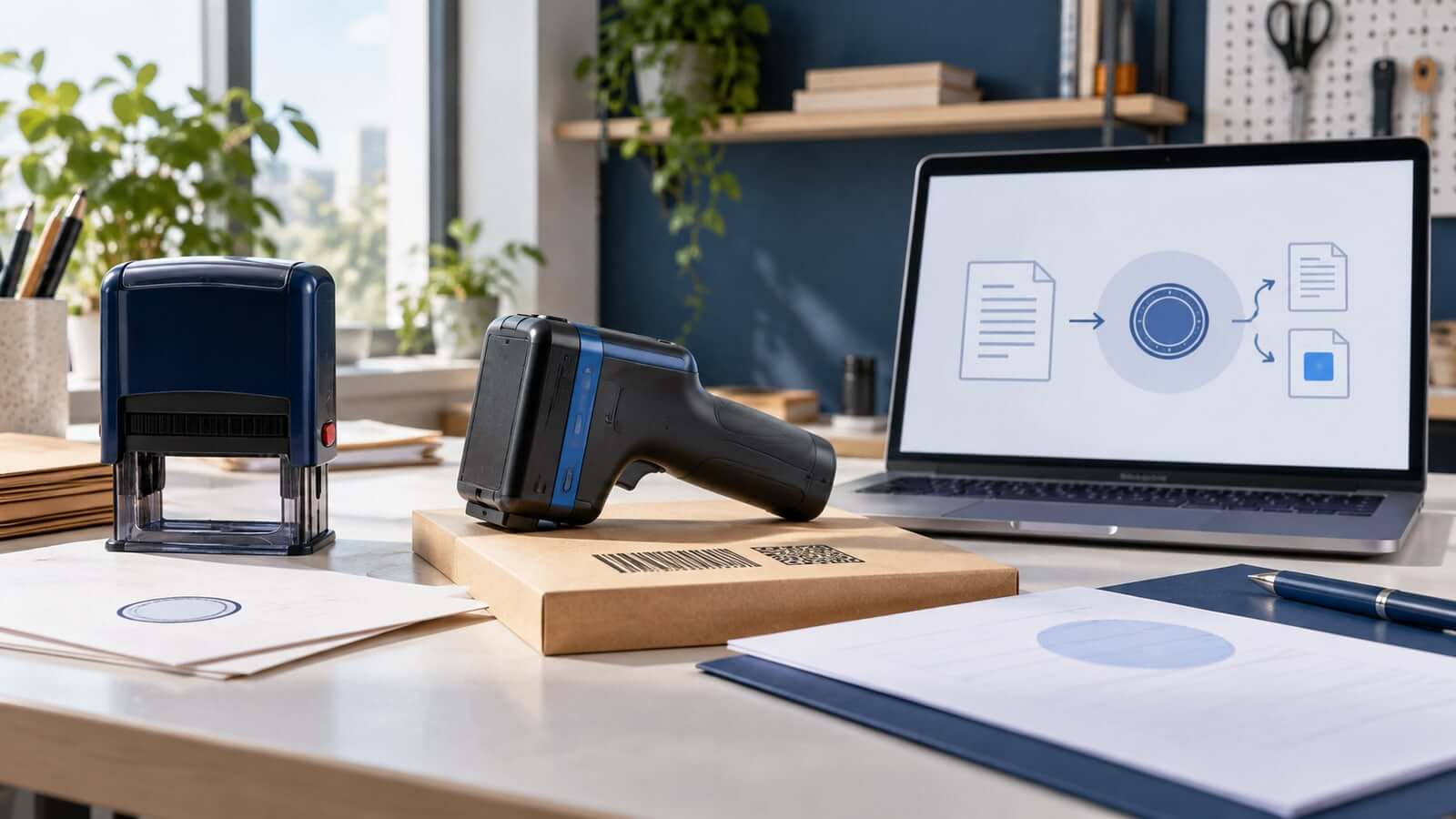
An office buyer opens four browser tabs after searching for stamp news. One announces new self-inking models. Another demonstrates a handheld color printer. A third explains laser engraving. The fourth discusses an electronic-seal regulation. Every page uses the word “stamp” or “seal,” but the products solve different problems.
That distinction matters more than the novelty of any single announcement. A physical device repeats an ink impression. A mobile printer can vary content from one pass to the next. A visual stamp image can be placed in a document. A regulated electronic seal uses certificates and trust services to support origin and integrity. Buying or designing one as though it were another creates expensive confusion.
This September 2026 update examines four developments that are useful to ordinary stamp buyers and design teams. It separates confirmed changes from interpretation, then translates each item into a practical decision. It is not a prediction that one technology will replace the rest.
In February 2026, Trodat announced four additional models in its Printy 4.0 range: a phrase-and-date model, a text-and-date model, a numberer, and a text stamp. The announcement emphasized familiar mechanical concerns such as handling ink cartridges, covering bands on applicable models, and maintaining common pad-color options.
The news is less dramatic than a new digital platform, and that is exactly why it is instructive. Physical stamp development continues to focus on repeated daily actions: changing a pad without staining fingers, positioning dates or numbers, and fitting a dependable device into an established desk process.
For a buyer, the practical questions remain concrete:
- Does the device carry fixed text, changing bands, or both?
- Is the impression area large enough for the approved wording?
- Can staff replace the pad and text plate without rebuilding the whole tool?
- Will the date format, numbering range, and language match the workflow?
- Who will inspect the device when an impression becomes incomplete?
A new body does not rescue a crowded design. Before selecting hardware, use a to test the actual wording and hierarchy. The device and the artwork should be chosen together, but they are separate decisions.
The current COLOP e-mark product line shows how far the verb “stamp” has expanded. It is a battery-powered mobile inkjet device rather than a relief plate pressed into an ink pad. Its official specifications describe full-color output, stored imprints, automatic date and numbering functions, and QR-code and barcode generation. It is intended for suitable absorbent surfaces and is controlled through mobile or desktop software.
This is not simply a rubber stamp with more colors. The content can change between passes. That makes mobile marking useful for sequences, dates, small batches, labels, packaging, and other jobs in which a fixed plate would require manual fields or several devices.
The tradeoffs also change. A rubber plate asks whether fine lines will survive engraving and ink transfer. A mobile inkjet device asks whether the surface absorbs the ink, whether the print path stays straight, whether the cartridge suits the job, and whether variable data is correct before each run.
Teams considering mobile marking should create two proofs. The first is a clean artwork proof that checks wording, spacing, and contrast. The second is a device-and-surface proof that checks movement, absorption, drying, and data changes. A good screen preview cannot answer the second set of questions.
Laser engraving is established rather than new, but the surrounding workflow continues to become more software-driven. Current engraving guidance from equipment makers describes dedicated stamp modes that can create a mirrored, inverted relief, add a cutting contour, and control the shoulder around raised characters.
That automation changes the handoff between a designer and manufacturer. A designer should not assume that every supplier wants a pre-mirrored negative. In some stamp workflows, the driver performs those transformations. If the artwork is mirrored twice, the finished impression will be wrong.
The durable lesson is to send an intelligible master and ask the supplier what its production software will do. Confirm:
- whether the submitted artwork should read normally;
- whether the supplier creates the negative and mirror;
- which line and gap limits apply to the chosen rubber and size;
- whether the contour is supplied or generated;
- how the production proof will show the final reading direction.
Software can make production more repeatable, but it does not make every design manufacturable. Small counters, isolated dots, tightly spaced letters, and thin borders may still fail after engraving, cleaning, mounting, inking, or stamping. The machine workflow is one part of the result.
The most important terminology news arrived outside the rubber-stamp market. Commission Implementing Regulation (EU) 2026/248, adopted in February 2026, sets technical formats or associated containers for advanced electronic signatures and advanced electronic seals that public-sector bodies must recognize when they require those tools for an online service. It replaced an earlier implementing decision.
This does not turn a PNG seal, scanned impression, or decorative company mark into an advanced electronic seal. Under the European trust-services framework, electronic seals are data associated with other electronic data and exist within a technical and legal system. Qualified versions involve qualified providers, certificates, validation, and trusted lists.
SealsDigital creates visual stamp artwork. That artwork may communicate a status or identity chosen by the user, but it does not provide a certificate, cryptographic origin proof, qualified status, or tamper evidence. Organizations that need an advanced or qualified electronic seal must use an appropriate trust service and verify the requirements that apply to the jurisdiction and service.
The 2026 rule is still relevant to visual-stamp users because it clarifies the vocabulary. Ask whether a request means:
- a visible mark that readers can recognize;
- an image placed on a PDF;
- a conventional electronic signature;
- an advanced electronic signature or seal;
- a qualified trust service.
Those options can appear together, but they are not substitutes.
The four developments point in different directions. Physical self-inking devices are improving familiar operations. Mobile inkjet tools make the impression variable. Laser software automates more production transformations. Electronic-seal rules define technical trust, not graphic appearance.
Use this decision table before reacting to a headline:
| Headline concerns | Main decision | Proof required |
|---|---|---|
| New self-inking model | device size, mechanism, pad and plate | repeated physical impressions |
| Mobile inkjet marking | surface, motion, cartridge and variable data | device pass on the real material |
| Laser engraving workflow | relief geometry and supplier settings | production proof from the final file |
| Electronic-seal regulation | identity, certificate, provider and validation | technical and legal compliance evidence |
| Visual stamp artwork | wording, hierarchy, size and file format | real-size visual proof in context |
The existing guide to provides a deeper comparison of destination and control. The 2026 news adds two more branches: variable mobile printing and regulated trust services.
News coverage often starts with a feature. Procurement should start with the repeated job.
Write down the content that stays fixed, the content that changes, the surface, the number of impressions, the people allowed to use the mark, and the record that proves a decision. Then choose the technology.
For example, a receiving desk may need a durable physical device with a writable date field. A small packaging team may benefit from variable mobile printing. A remote office may need a transparent image for an internal PDF workflow. A company submitting documents to an EU public service may need a conforming electronic trust service. The same circular logo could appear across those uses, but the controls and output are different.
Do not let a product category inherit authority from another. A realistic digital impression is still an image. A QR code is only useful when its destination is maintained. A timestamp printed on paper is not a trusted electronic timestamp. A physical company seal may carry organizational meaning without providing cryptographic evidence.
A product announcement confirms that a model or feature has been presented; it does not prove that the option is available in every country, fits every existing device, or improves a particular office. A regulatory update defines a scope; it does not automatically change the requirements for an unrelated private document.
Check regional availability, current specifications, replacement supplies, and supplier support before purchasing. For formal electronic services, confirm the applicable rule and provider status instead of relying on a general news summary. Treat this article as a dated map of the categories, then verify the final choice against the organization that supplies or accepts it.
The safest design response is not to create one overloaded stamp that attempts every job. Build a clear master identity and create controlled variants.
A fixed rubber version may remove variable dates. A mobile-print version may reserve space for numbering. A PDF overlay may use transparency and a quieter texture. A regulated electronic seal may have no need for the decorative artwork at all, although a visible representation could appear beside the technical validation information.
Keep the shared elements deliberate: approved name, spelling, hierarchy, basic shape, and version owner. Record the differences by destination. The broader can help with visual options, but each output needs its own production and authority checks.
What is the biggest stamp technology change in 2026?
There is no single replacement technology. The clearest change is specialization: conventional devices, mobile inkjet marking, laser-production software, visual document assets, and cryptographic electronic seals now occupy distinct roles.
Is a mobile inkjet marker the same as a self-inking stamp?
No. A self-inking stamp presses a fixed relief plate through an internal ink mechanism. A mobile inkjet device prints content as it moves across a suitable surface and may support variable information.
Should laser stamp artwork be mirrored before sending it?
Only if the manufacturer specifically requests it. Some stamp-mode software mirrors and inverts the artwork automatically. Confirm the supplier's workflow to avoid a double transformation.
Does the 2026 EU regulation apply to a visual company-seal image?
Not by itself. The regulation concerns recognized technical formats for advanced electronic signatures and seals in its defined public-sector context. A visual image does not become an advanced electronic seal through appearance alone.
Are new stamp devices automatically more sustainable?
No. Examine materials, replaceable parts, consumables, service life, transport, and actual use. Manufacturer claims should be checked for the specific model and market rather than generalized across a category.
The useful stamp news of 2026 is not a story of paper disappearing or one smart device taking over. It is a story of clearer branches. Mechanical stamps continue to improve. Mobile printers handle changing content. Laser systems shift production steps into software. Electronic-seal rules become more technically specific.
Start with the job, then identify the layer: impression, image, variable print, or trust service. Once that choice is explicit, design and procurement become much easier to evaluate—and a headline is less likely to send the team toward the wrong tool.
