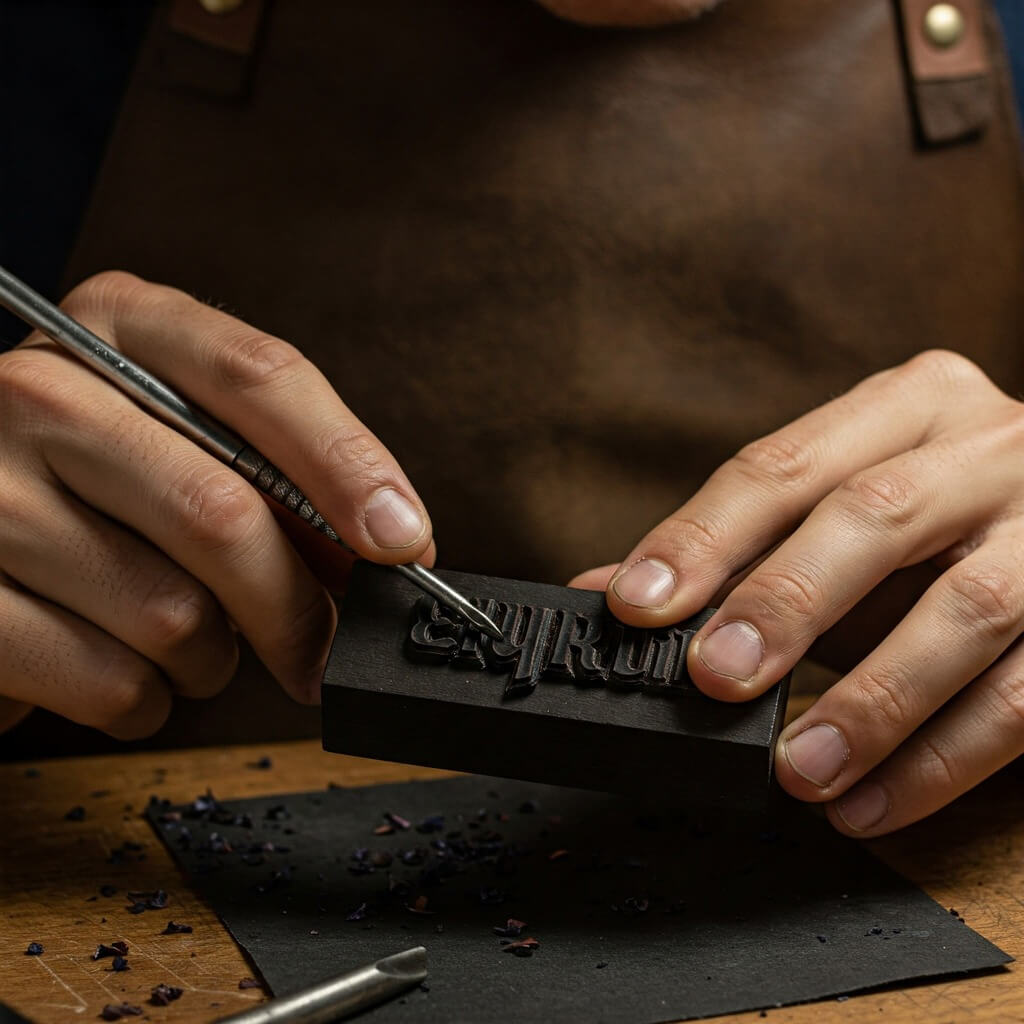
"Seal" and "stamp" are used for several different objects. A wax seal is a small metal die pressed into melted wax. An embosser presses a raised design into paper without ink. A rubber or polymer stamp transfers ink. A digital stamp is artwork placed on a file. Each is made in a different way, and each needs slightly different artwork from you.
This overview explains how each type is produced today, what the maker needs from you, and how to choose between them.
A wax seal stamp is a metal die, commonly brass, fixed to a handle of wood, metal, or another material. The design is cut into the face of the die so that it comes out raised in the wax.
Most dies are now engraved by machine, with a CNC engraver or a laser working from a digital file. Hand engraving is still offered by specialist engravers for custom and heraldic work, and some dies are cast from a master.
The wax matters as much as the die. Traditional sealing wax is brittle once it cools. Flexible wax, often sold as sticks for glue guns, is designed to bend without cracking, which makes it better suited to envelopes that go through the post.
Artwork needed: a simple, bold, one-color design. Wax seal faces are small, often around the size of a coin, so monograms, initials, and simple emblems work better than detailed logos or long text.
An embosser uses a matched pair of dies: one with the design raised and one with it recessed. When paper is squeezed between them in a hand-held or desk press, the design stands up from the sheet. No ink is involved.
The dies are often metal plates, etched or engraved from a digital file and then fitted into the press. Some embossers are sold as complete units; others take replaceable die inserts.
Embossing works with relief only, so there is no color and no fine tonal contrast. Thin lines and very small text tend to flatten out or tear the paper, and heavier paper holds a crisper impression. If your design started as an ink stamp, it usually needs adjusting first; see for what to change.
Artwork needed: a one-color vector file with generous line weights and spacing, at the exact finished size, plus details of the paper you plan to use.
Most office and craft stamps are made by one of four methods.
Molded (vulcanized) rubber. A mold, called a matrix, is made from a printing plate of the design. Rubber sheet is pressed into the matrix and cured with heat. The method suits making many copies of the same design.
Laser-engraved rubber. A laser removes the rubber around the design directly from a sheet, leaving the design raised. No mold is needed, so it suits single stamps and short runs, and it can hold good detail. The covers how to prepare files for this process.
Photopolymer. Liquid polymer is exposed to UV light through a film negative of the design. The exposed areas harden and the rest is washed away. Clear craft stamps that cling to acrylic blocks are usually made this way, and some suppliers use polymer for office stamp dies as well.
Pre-inked (flash) stamps. The die is a porous material that holds ink inside it. The design is formed by sealing the surface around it with a flash of light and heat through a film, so ink can only escape through the design. These stamps give clean impressions and many uses between refills.
The die is only half of the product. How it is mounted changes how it is used.
- Traditional mount: the die is glued to a wooden or acrylic block and used with a separate ink pad. You can choose any compatible ink, including inks made for non-porous surfaces, and large sizes are possible.
- Self-inking: the die sits in a mechanism that rests on a built-in pad and flips down onto the paper. It is fast for repeated stamping, and the pad is replaceable. The impression size is fixed by the model, so the artwork must fit that model's plate.
- Pre-inked: the ink is held in the die itself, as described above. Refill it with the ink the maker specifies.
- Daters and numberers: self-inking mechanisms with rotating bands for dates or numbers, sometimes combined with a fixed text plate.
A digital stamp is not manufactured at all. It is artwork created in an editor and exported as an image or vector file. It is used on PDFs and other documents, and the same file is usually the starting point for any physical stamp.
With SealsDigital you can start from or a blank layout, add curved and straight text, borders, shapes, or an uploaded logo, and set the ink color. Exports include transparent PNG for documents and SVG, EPS, or PDF for stamp makers. SealsDigital makes digital artwork only; to get a physical stamp, you give the vector file to a stamp maker.
A digital stamp is visual artwork. It is not a cryptographic digital signature or electronic seal, and it does not prove identity or show whether a document was changed.
Most makers ask for the same basics, with a few differences:
| Method | Key artwork requirements |
|---|---|
| Wax seal die | Bold one-color design, small size, minimal text |
| Embosser | One color, generous line weights and spacing, exact size, paper details |
| Molded or laser-engraved rubber | One-color vector at actual size, lines above the maker's minimum width |
| Self-inking stamp | Artwork that fits the model's impression area with a margin |
| Digital stamp | Transparent PNG at a suitable resolution, plus a vector master |
A few rules apply to all of them. Send a vector file (SVG, EPS, or PDF) when you can. Make the artwork solid black or one color, without gradients or tints. Supply it at the finished size, or state the size clearly. Most makers expect right-reading artwork and handle any mirroring themselves, so confirm before you flip anything. Ask each maker for their minimum line width and text height, because these depend on the process and the equipment.
Start with where the mark will go and how often it will be used:
- Many paper documents a day with the same wording: a self-inking stamp.
- A date or number that changes: a dater or numberer.
- Packaging, kraft paper, fabric, or wood: a traditional mount with an ink suited to the surface.
- Certificates or formal documents where a raised seal is expected: an embosser.
- Invitations, letters, and gift wrapping: a wax seal.
- PDFs and email: digital stamp artwork.
Many organizations end up with more than one. The easiest way to keep them consistent is to design one master file and adapt it for each method, rather than designing every version separately.
If the wording might change, think about that before you order. A digital file is cheap to update, while a physical stamp has to be remade when an address or name changes.
For more on preparing stamp files for production, browse our .
What is the difference between a seal and a stamp?
In everyday use the words overlap. "Seal" often refers to a wax seal, an embossed seal, or the official round mark of an organization, while "stamp" usually means an inked impression. The production method, not the name, determines what artwork you need.
Is laser-engraved rubber better than molded rubber?
Neither is better in every case. Laser engraving needs no mold, so it suits single stamps and short runs and handles detail well. Molding suits larger runs of the same design. Ask your maker which process they use and what minimums apply.
Can I use my ink stamp design for a wax seal or embosser?
Often, but it usually needs simplifying. Wax seals are small, and embossers rely on relief rather than ink, so thin lines and small text should be thickened or removed. Ask the maker for a proof before production.
Does a digital stamp replace a physical seal?
Not always. A digital stamp is an image and does not have the standing of a signature, notarization, or a qualified electronic seal. Where a raised seal, a wet-ink stamp, or an electronic signature is required, use that method and check the rules that apply to your documents.
