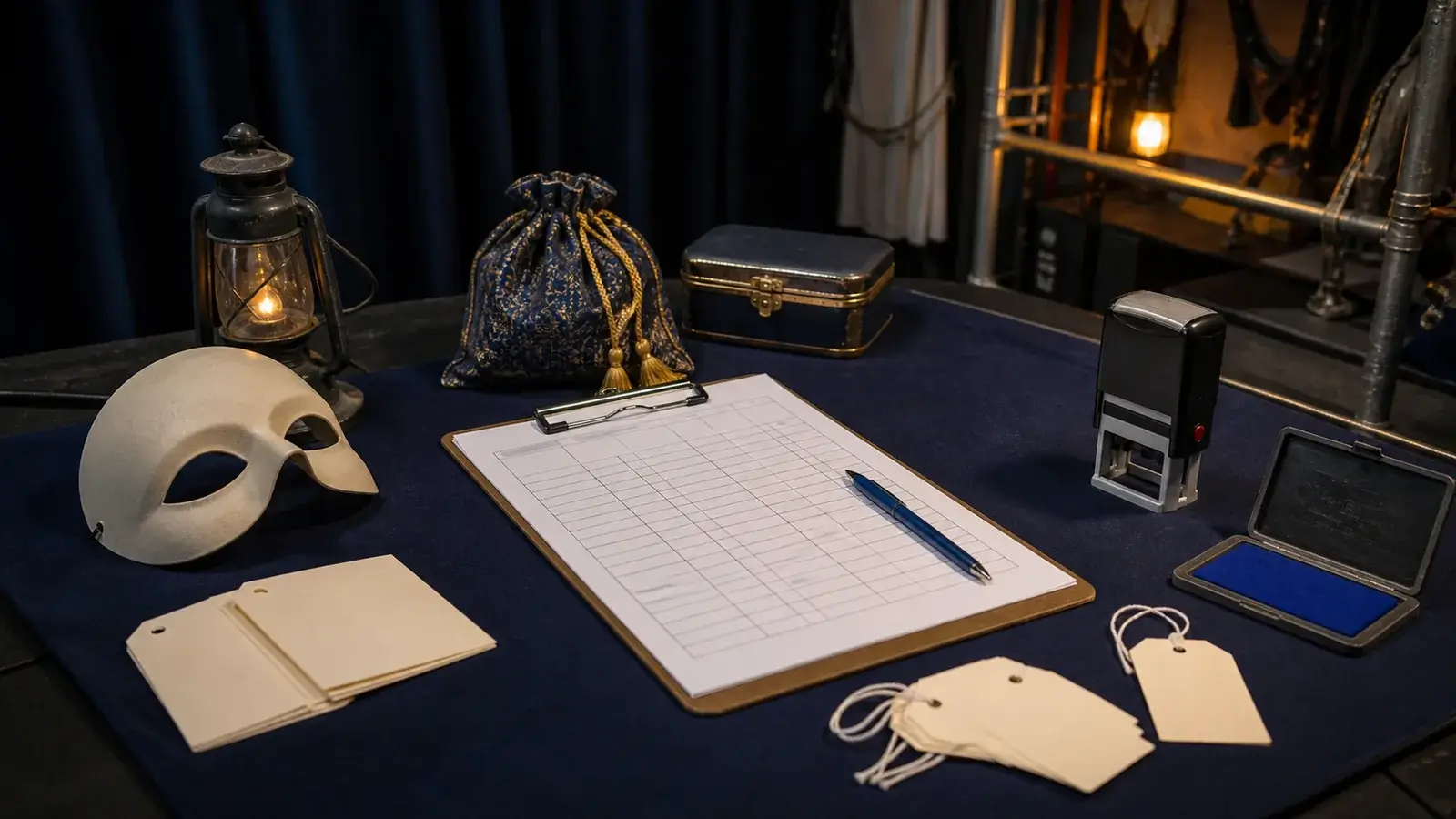
The stage manager calls the preset check, and one hand prop is missing from the stage-left table. The rehearsal-room list says it was returned. A repair note says the handle was loose. The performer remembers placing it in a transport case after the last run, but two similar cases are now backstage.
A community theatre prop stamp can keep item identity, location, readiness, and next ownership connected across rehearsal and performance. It should not certify that a prop is safe, licensed, authentic, or suitable for use. Those decisions belong to the production’s approved technical, safety, rights, and management processes.
The useful mark is not a decorative theatre emblem. It is a compact workflow tool on an inventory card, rehearsal sheet, repair tag, preset list, or storage record.
Names change quickly in rehearsal. Old letter, hero glass, and small bag may each refer to several objects. Start with one stable production ID.
The ID should appear on:
- the master prop inventory;
- the item tag or removable container label;
- rehearsal sign-out records;
- preset diagrams or lists;
- repair and alteration notes;
- transport cases;
- duplicate or backup records;
- strike and storage sheets.
Use a neutral code that can survive casting and staging changes. P-023 remains useful if the prop moves from one scene to another. A code based on an actor name or rehearsal nickname may become misleading.
If the prop cannot be marked directly, attach the ID to a fitted bag, tray, box, or card. Avoid permanent marks on borrowed, rented, fragile, historically significant, or personally owned objects unless the authorized owner and procedure permit them.
Photographs can help staff distinguish similar items, but the image should point to the same ID. A photo without an inventory reference creates another disconnected list.
The production needs states that match physical handoffs. A practical lifecycle could be:
- Stored: in the approved home location and not assigned to the current rehearsal or show.
- Rehearsal issue: released to a named rehearsal room, scene, or responsible person.
- Preset: placed at the defined stage or backstage point for the current run.
- In use: controlled by the performer or crew role defined in the handoff.
- Returned: checked back to the preset or storage owner after use.
- Repair hold: removed from normal use pending the production’s approved review.
- Missing or mismatch: item or record cannot be reconciled and needs a named resolver.
The production may use different terms. Keep each state linked to one decision and one owner. READY is too broad if it might mean repaired, transported, preset, or performer-confirmed.
Do not try to put every state in one ornate impression. A can provide a clean fielded base with the production’s plain status language. Avoid shields, official crests, and imitation inspection seals.
The card should capture what changes as the prop moves. Useful fields include:
- production and prop ID;
- short controlled description;
- quantity and duplicate reference;
- current state;
- current location;
- issuing and receiving role references;
- date and time when the sequence needs it;
- scene, rehearsal, or performance reference;
- repair or exception reference;
- expected return point.
Keep performer contact details, incident information, rights documentation, and sensitive notes in their approved records. The prop card needs operational references, not a copy of every production file.
Use role names that remain stable across changes, such as stage-left props, assistant stage manager, wardrobe, or performer role. If the individual changes, update the assignment record without rewriting the lifecycle definition.
Leave enough handwriting space for the longest location and exception references. A field that fits SL may fail when the actual holding point is rehearsal room locked cabinet.
PRESET is useful only when the production defines where and for which run. A prop placed correctly for the matinee may be wrong for the evening performance after a scene change.
A preset entry can include:
- performance or run reference;
- preset side, table, mark, pocket, or scenic location;
- quantity;
- item orientation or container reference where relevant;
- person completing the physical placement;
- checker and check time;
- exception or substitution reference.
Do not stamp the preset complete before physically checking the item. A list copied from yesterday is not today’s preset.
Use a layout that allows a second check without hiding the first. If the prop moves during interval, create a separate interval reset state. Avoid a general SHOW READY mark that mixes props, wardrobe, scenery, sound, and performer calls.
When a substitute is used, preserve the original prop ID and add the substitute’s own ID. Do not relabel the substitute as the original simply because it serves the same dramatic function.
Some props move from a table to a performer, then to another performer, a crew member, or a return basket. Map the expected path before opening night.
For each handoff, define:
- item ID and quantity;
- giving role;
- receiving role;
- handoff point or cue reference;
- return owner;
- fallback when the expected receiver is absent;
- person allowed to alter the route.
The paper mark can confirm that the operational handoff was recorded. It does not prove personal custody or fault. Keep the language neutral, especially when an item is missing.
If a cue changes, update the controlled prop track and mark the effective rehearsal or performance. Loose notes in the wings can survive after the official route changes.
The same separation between zone, state, and owner is useful in . Access teams track people moving between controlled gates; prop teams apply the principle to objects moving between rehearsal, preset, performance, and return points.
Two props that look alike may have different uses. Give each physical item its own ID or controlled suffix.
For example:
P-023-Aperformance item;P-023-Bbackup;P-023-Rrehearsal version;P-023-C1first consumable unit or batch reference.
These are example patterns. Choose one that fits the production.
Do not use duplicate as the entire description. Record the relationship and the physical differences that matter to routing. A rehearsal breakaway, non-working replica, or lightweight substitute should not be confused with another version merely because the audience sees the same object.
Consumables need a count and replenishment owner. Record the unit used or remaining according to the production’s procedure. A stamp should not certify food safety, allergy status, flame treatment, electrical safety, weapon status, or any other specialist requirement.
A repair note on a prop table is easy to miss. Move the item to a defined repair-hold location and change its state in the inventory.
The repair entry should record:
- prop ID;
- observed issue in plain language;
- discovery date and context;
- person removing it from normal use;
- holding location;
- assigned reviewer or department;
- substitute or scene impact reference;
- decision and release entry.
Describe observations rather than diagnosing beyond the team’s role. Handle loose during return check is clearer than safe after tightening unless the authorized production process supports that decision.
Do not place a repaired prop back into preset storage before the approved reviewer closes the hold. REPAIR COMPLETE and RELEASED TO USE may be separate decisions.
Preserve the repair history when the prop returns. Erasing the hold can make repeated issues harder to recognize in the production record.
Touring, shared venues, and borrowed props add another handoff layer. The transport record should connect the prop ID to a case, vehicle or route reference, departure, receiving team, and condition observation.
Use removable case lists and bag tags. Avoid stamping borrowed objects directly. Record any owner-provided handling instructions in the approved file and reference them from the operational card.
At receipt, compare quantities and item IDs before moving props into general rehearsal storage. Open an exception for missing components, mismatched cases, or observed packaging issues. Do not state that the owner caused a problem when the team has only observed the current condition.
The production’s agreements, insurance, venue rules, rights, and local safety requirements remain authoritative. A visual prop stamp creates no legal permission or certification.
The post-show return is part of the performance workflow, not optional cleanup. Assign a named person on each side or zone to reconcile props.
Use a short run-close routine:
- Return each item to its defined basket, table, or owner.
- Compare item IDs and quantities with the track.
- Record consumables and duplicates used.
- Open repair holds for observed issues.
- Resolve or assign missing and mismatched items.
- Prepare interval or next-show resets separately.
- Update the show report with references to open exceptions.
Avoid marking the whole table CLEAR while one item is still with a performer or repair team. The table state and item state are different.
During a multi-show day, keep each performance reference visible. A mark from the matinee should not be mistaken for the evening preset. Use date, run code, and time in a consistent order.
Backstage light can be low, tables crowded, and cards handled repeatedly. Print the impression at intended size and test it on the real inventory card or label.
Check whether:
- the prop ID is readable at arm’s length;
- state labels remain distinct in low light;
- handwriting fits without crossing a border;
- the impression survives copying and scanning;
- the card can be attached without damaging the item;
- the mark is clearly internal rather than official;
- corrections preserve the earlier state.
Ask a crew member who did not design the system to follow a sample prop from storage to preset, handoff, return, and repair hold. Any point that requires verbal interpretation needs clearer wording or ownership.
Store one approved source file and retire previous versions. Production changes are frequent, but uncontrolled layouts create more ambiguity than they solve.
What information belongs on a prop card?
The production and prop ID, description, quantity, current state, location, giving and receiving roles, run reference, return point, and repair or exception reference.
Does a READY stamp certify that a prop is safe?
No. A visual mark does not certify safety, inspection, rights, ownership, licensing, authenticity, or suitability. Use the production’s approved specialist reviews and records.
Should borrowed props be stamped directly?
Usually a removable card, bag tag, case list, or linked record is safer. Follow the owner agreement and production procedure before marking any object.
How should duplicate props be identified?
Give each physical item a unique suffix or ID and record its role as performance, backup, rehearsal, or consumable. Do not rely only on appearance.
When should a repair hold close?
Only after the production’s authorized review and release process is complete. Repair work and permission to return the item to use may be separate decisions.
Reliable prop tracking begins with one ID per physical item and a lifecycle the whole backstage team can understand. Storage, rehearsal, preset, use, return, repair, and exception states should each point to a location and owner.
Keep the mark on controlled cards, tags, and records where possible. Preserve substitutions, repeated repairs, and missing-item histories rather than overwriting them. More event-oriented design patterns are available in the , but the final state names should match the production’s actual cue paths. A prop system earns trust when the next crew member can find the object and understand its status without locating the person who wrote the note.
