In 2025, medical seals remain indispensable tools for healthcare documentation, blending time-honored traditions with cutting-edge production methods. This guide delves into every stage of seal creation—from understanding international regulations to selecting optimal materials, leveraging online design platforms, and ensuring long-term performance. Whether you are a solo practitioner ordering your first stamp or a large hospital standardizing documentation workflows, this resource equips you with the knowledge to produce clear, compliant, and durable seals that streamline operations and reinforce patient trust.
Medical seal requirements vary by jurisdiction, yet share core principles of authenticity, legibility, and professional accountability. In the United States, most state medical boards mandate a circular seal displaying the practitioner’s full legal name, medical degree designation, and license number. Federal regulations prohibit alteration of these seals across documents, and violations can trigger disciplinary action.Canada’s provincial medical authorities similarly require doctor stamps to include the physician’s legal name and licensing jurisdiction, with optional inclusion of a hospital or clinic logo. The diameter typically ranges from 25 mm to 38 mm, ensuring clear impressions on paper charts and electronically scanned records.In the European Union, member states’ medical councils align with EU directives governing medical device traceability. Seals on prescriptions must include a CE marking when used on medical device packaging, in addition to the healthcare provider’s details. Bilingual seals (local language plus English) are common in regions with multiple official languages.Across Asia and Latin America, regulatory frameworks emphasize inclusion of national medical council registration numbers and official clinic addresses. Digital seals are gaining acceptance, provided they adhere to e-signature standards such as India’s IT Act or Brazil’s ICP-Brasil architecture.
Successful seal design harmonizes regulatory compliance with visual clarity and brand identity. Key considerations include text hierarchy, border definition, symbol placement, and contrast optimization. Begin by selecting a legible font family—serif typefaces like Times New Roman or humanist sans-serifs such as Calibri ensure sharp reproduction even at small point sizes.
- Text Hierarchy: Place the practitioner’s name prominently in the center, with credentials and license number in smaller outer circles.
- Border Definition: Use dual concentric rings to frame content and prevent edge smudging.
- Symbol Integration: Incorporate medically-relevant icons (e.g., Rod of Asclepius) sparingly, ensuring they do not encroach on critical text.
- Contrast: Opt for high-visibility inks like jet black or ultramarine blue against white paper.
Consider the final application: seals used on glossy prescription pads may require slightly bolder line weights than those for matte charts. Plan your design with ink bleed in mind, leaving ample white space around text and symbols.
Selecting the right seal material involves balancing durability, clarity of impression, and production cost. The two most widely-used substrate categories are hard rubber and photopolymer. Hard , laser-engraved on vulcanized matrices, deliver crisp, long-lasting impressions but require longer lead times.Photopolymer plates, cured using UV exposure, offer rapid turnaround (often within 24 hours) and excellent fidelity for multi-line or logo-heavy designs. However, polymer seals may wear faster under high-volume usage—typically rated for up to 5,000 impressions before replacement.
Self-Inking vs. Manual Stamps
Self-inking housings combine a built-in ink pad with a spring mechanism, delivering consistent impressions for up to 10,000 cycles per cartridge refill. Manual stamps, requiring separate ink pads, incur lower upfront costs but demand routine maintenance and carry a higher risk of uneven ink distribution.
- Hard Rubber: High abrasion resistance, ideal for heavy-use clinics.
- Photopolymer: Fast production, ideal for multi-line or color seals.
- Self-Inking: Consistent impressions, minimal user effort.
- Manual Ink Pad: Cost-effective, customizable ink colors.
Modern seal production leverages both traditional craftsmanship and automated manufacturing. Laser engraving systems use CAD files to pulse high-precision beams on rubber substrates, carving micro-fine details down to 0.1 mm. Photopolymer workflows employ custom masks and UV curing tables to polymerize resin layers in a single exposure.
CNC Milling
Computer Numerical Control (CNC) milling machines refine seal surfaces on acrylic or metal blocks, carving complex relief patterns. These systems excel at producing rigid, nickel-plated seals favored by institutional laboratories for repeated sterilization cycles.
3D Printing
Emerging use of high-resolution 3D printers allows rapid prototyping of seal masters. Stereolithography (SLA) printers can achieve layer resolutions down to 25 microns, enabling proof-of-concept verification before committing to final substrates.
For high-volume orders, rotary die-cutting and inline ink pad installation streamline assembly, reducing per-unit labor costs and ensuring consistent alignment across batches.
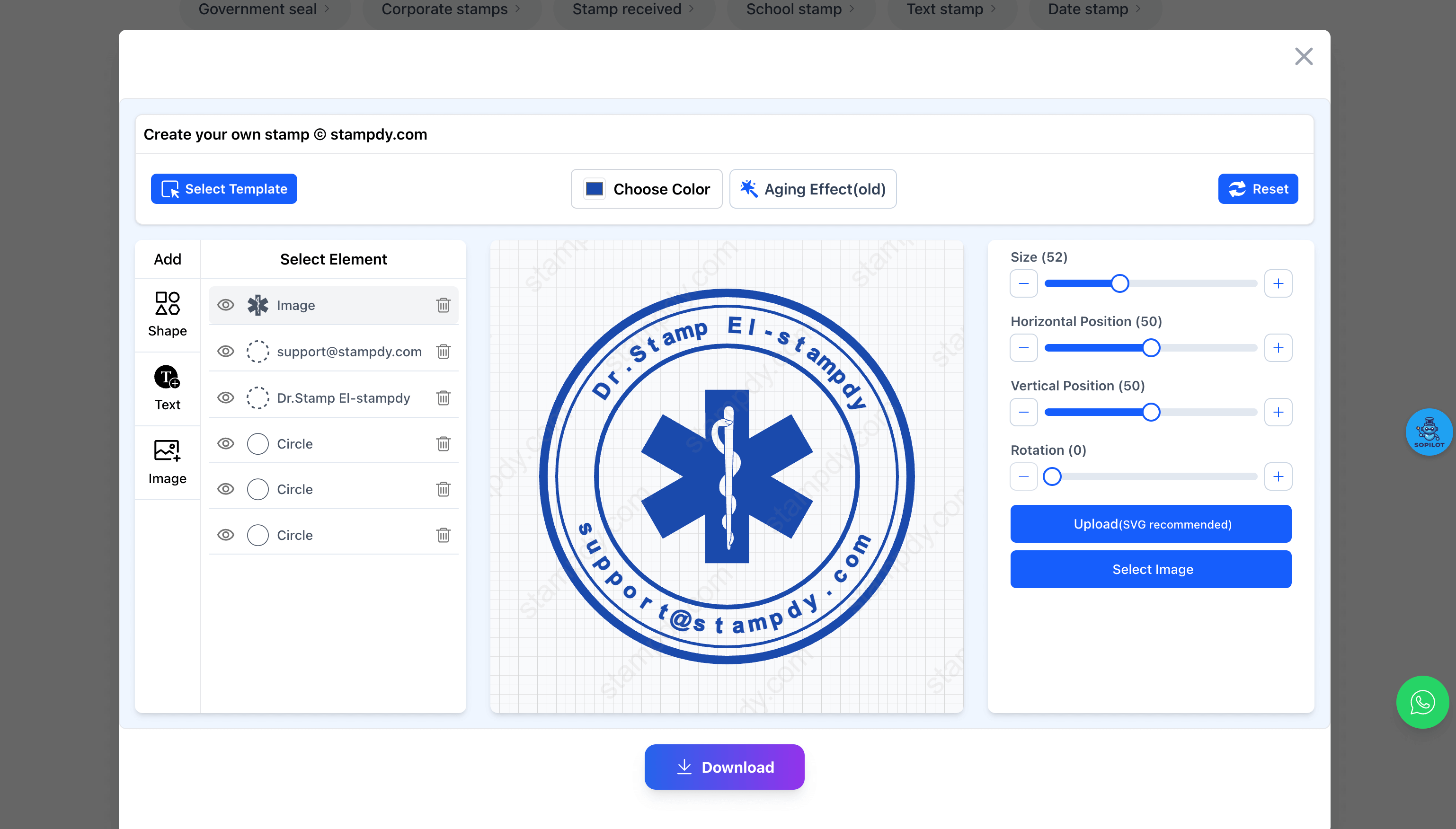
Clinics and solo practitioners increasingly rely on browser-based seal designers, which eliminate the need for specialized software. These platforms feature drag-and-drop interfaces for arranging text, symbols, and borders within predefined templates.
- Real-Time Preview: View live mockups on simulated prescription pads and chart backgrounds.
- Template Library: Access medical-specific layouts approved by regulatory bodies.
- Vector Export: Download print-ready SVG, PDF, or EPS files.
- Collaboration Tools: Share drafts with colleagues for instant feedback.
Look for platforms offering integrated production services, where final designs automatically route to partnered manufacturers, streamlining the ordering process.
Seamless integration of seals into electronic health records (EHR) enhances traceability and reduces manual errors. Many EHR systems now support digital seal stamps, allowing providers to apply cryptographically signed impressions directly onto digital prescriptions and referral letters.
- Template Integration: Preload digital seal images into EHR document templates.
- Access Controls: Restrict seal usage to authorized user accounts.
- Audit Logs: Record each seal application event with timestamp and user ID.
- Backup Prints: Maintain physical seals for offline or emergency scenarios.
For paper-based workflows, position physical seal stations near nursing stations or administrative desks, ensuring consistent pressure and alignment by using alignment jigs or registration guides.
Maintaining seal performance requires routine inspection and validation. Implement a quarterly audit process where each seal is tested on standardized test sheets, checking for completeness of impressions, even ink distribution, and absence of spurious marks.
- Impression Count Tracking: Replace seals after manufacturer’s rated cycle count.
- Ink Replenishment Schedule: Refill or replace ink pads every 1,000 impressions.
- Surface Cleaning: Use lint-free wipes and isopropyl alcohol to remove residue.
- Damage Inspection: Examine rubber edges for nicks or tears.
Document all maintenance activities in a centralized log to support accreditation surveys and regulatory compliance.
Proper storage preserves seal integrity. Store seals upright, in sealed containers with silica gel packets to control humidity. Avoid direct sunlight and extreme temperatures, which can warp rubber and degrade photopolymers.
- Temperature Control: Maintain ambient temperatures between 15°C and 25°C.
- Humidity Management: Keep relative humidity below 50%.
- Protective Cases: Use padded containers for transport and field use.
- Periodic Rotation: For seldom-used seals, apply impressions monthly to prevent ink pad drying.
Label storage containers clearly with seal identifiers and last maintenance date to facilitate quick retrieval and ensure rotation schedules are met.
Looking ahead, technology continues to evolve. Blockchain-secured physical seals promise tamper-evident authentication, linking each impression to an immutable ledger entry. Advanced smart inks that change color under UV light will offer on-demand verification of genuine impressions.Biometric-linked digital seals, bound to individual user fingerprints or facial recognition, are under pilot in several telemedicine platforms. These innovations aim to enhance non-repudiation while maintaining the familiar form factor of traditional stamps.Sustainable materials—biodegradable polymers and post-consumer rubber composites—are gaining traction as healthcare systems pursue eco-friendly operations. Combining these advances with AI-driven design validation will usher in a new era of intelligent medical seal production.
From understanding global regulations to selecting materials, mastering production techniques, and ensuring ongoing performance, modern medical seal creation demands a holistic approach. By embracing , rigorous quality control, and sustainable innovations, healthcare professionals can equip their practices with reliable, high-quality seals that enhance efficiency and safeguard patient trust.Whether deploying traditional rubber seals in a busy clinic or integrating blockchain-backed digital stamps in telehealth platforms, the principles outlined here ensure that every impression carries the authority and clarity essential to modern medicine.
