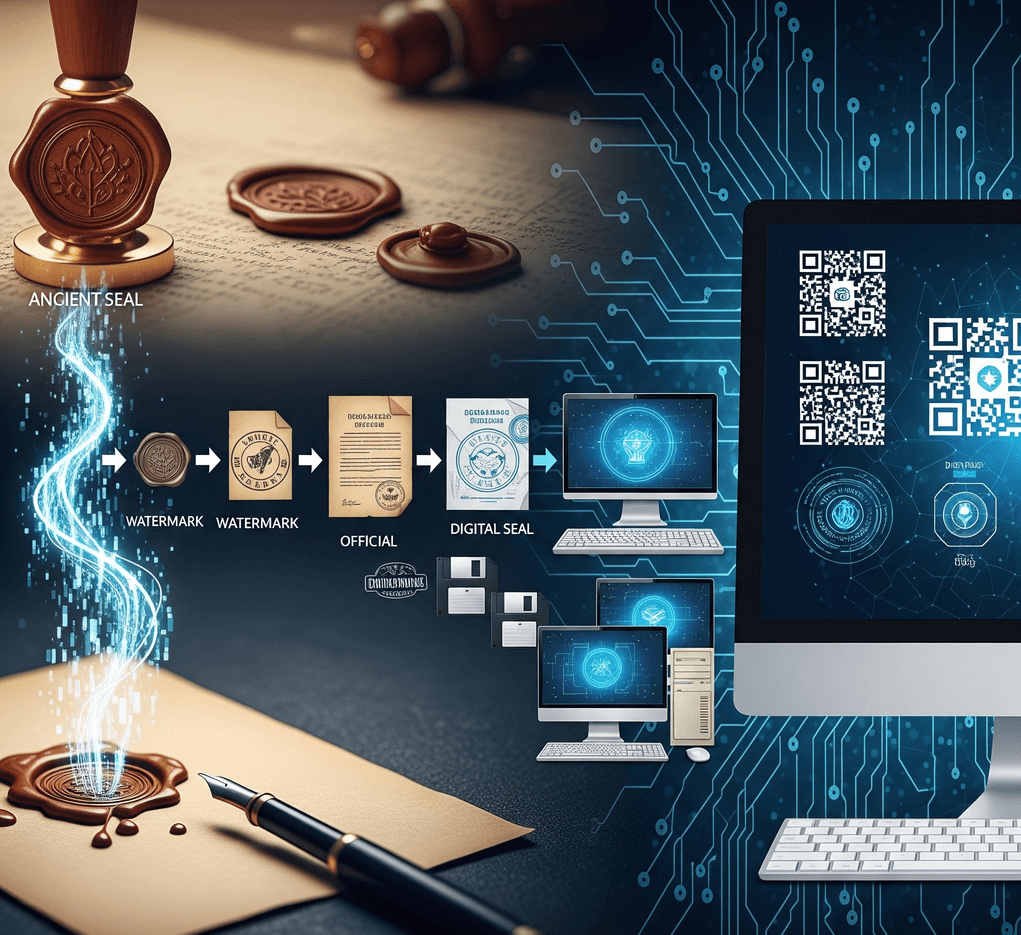
Today the phrase "digital seal" describes two different things. One is digital stamp artwork: an image of a round company seal or a "Received" stamp that you place in a document. The other is a certificate-based electronic seal: cryptographic data that lets software confirm where a document came from and whether it has changed.
Both descend from the long tradition of physical seals, but they arrived by different routes. This short history follows each one, keeps to well-established facts, and ends with what the story means for the stamps you use today.
Seals are among the oldest administrative tools. Thousands of years ago in Mesopotamia, people carved small stone cylinders that could be rolled across wet clay, leaving a continuous impression. Flat stamp seals pressed into clay were used across many ancient cultures. These marks identified an owner or official and were used on tablets, jars and the clay sealings that closed containers and doors.
That last use matters. A seal over a container did two jobs at once: it showed who had closed it, and it showed whether anyone had opened it since. Identity and integrity, the same two questions modern electronic seals try to answer, were part of sealing from the start.
In medieval Europe, wax seals were attached to charters, letters and legal documents. Rulers, bishops, towns and guilds kept their own seal matrices, and individuals often used signet rings. A seal was only as trustworthy as the control over the matrix, which is why seals were guarded and why forgery was treated seriously.
In East Asia, a separate tradition developed: seals carved from stone, wood, horn or other materials and pressed with red ink paste. Personal and organizational seals of this kind remain in everyday use in China, Japan and Korea.
As paperwork grew, sealing became faster and more routine. Embossing seals press a raised impression into paper without ink, and they are still used by notaries, companies and official bodies in some places.
The rubber stamp became practical after vulcanized rubber was developed in the nineteenth century. Rubber could hold fine detail, flex against uneven paper and survive heavy use. Offices adopted stamps for dates, addresses, signatures, approvals and status words such as Paid, Received and Copy. Later came self-inking stamps and adjustable date stamps, which made the process cleaner and more consistent.
By the twentieth century, the office stamp had become less a symbol of authority and more a workflow tool: a quick, recognizable way to record what had happened to a piece of paper. That role continues today, and many stamps still begin as before they are produced.
When scanners, fax machines and PDF files became normal office equipment, stamps followed documents onto the screen. The simplest method was to stamp a sheet of paper, scan it and paste the image into a digital file.
Scanned stamps work, but they bring problems along. Paper texture turns into a gray or off-white background. Edges blur, thin lines break up, and the image often carries a white box that covers whatever it is placed over. Each copy of a copy loses a little more detail. If you still rely on a scan, these steps for can make it usable.
The next step was to design the stamp as digital artwork from the start. Vector drawing software, and later online tools, made it possible to set curved text, borders and symbols precisely, choose an exact ink color, and export a clean image with a transparent background.
Digital artwork reversed the old order. Instead of making a rubber stamp and scanning it, many people now design the stamp digitally, use the image in documents, and send vector files to a manufacturer when they also need a physical stamp. With an , you can start from a template, edit the curved and straight text, choose a border, set the ink color and even add an aging effect that recreates the look of a worn impression.
What did not change is the nature of the result. However carefully it is designed, a stamp image is a picture. It shows a mark, but it does not record who placed it, when, or whether the document was altered afterward.
The second branch of the story comes from cryptography rather than from stamps. Public-key cryptography, developed in the 1970s, made digital signatures possible: a value calculated from a document's content and a private key that anyone can check with the matching public key. Change the document and the check fails.
To link keys to real people and organizations, public key infrastructure developed around digital certificates issued by certification authorities. Around the turn of the century, many jurisdictions passed laws giving electronic signatures legal effect.
The European Union later introduced the eIDAS Regulation, which defines both electronic signatures, used by individuals, and electronic seals, created by organizations to show the origin and integrity of data. Qualified versions rely on certificates from qualified trust service providers. In a sense, the electronic seal returns to the original purpose of the clay sealing: showing who closed the container and whether it has been opened since.
To see how these two lines compare in practice, read about .
The two traditions now often appear in the same file. Many signing tools let a certificate-based signature or seal display an image, so a PDF can show a familiar company stamp while the cryptographic data underneath does the verification work.
Physical stamps have not disappeared either. They are still common on packaging, in mailrooms, at intake desks and in paper-heavy processes. Many organizations run all three side by side: a rubber stamp at the counter, stamp artwork in everyday PDFs, and certificate-based signatures or seals for documents that need verifiable proof.
A few lessons carry over from clay to code:
- Know which job the mark does. Some marks communicate status or identity visually. Others must prove origin and integrity. Use artwork for the first and certificate-based tools for the second.
- Control the master. A seal matrix, a private key and a stamp file all need an owner and limited access. Keep the master artwork in one place and track who can use it.
- Keep the design consistent. People recognize a stamp by its shape, wording and color. Use the same design on paper and on screen.
- Do not overstate a picture. A stamp image is useful, but it is not a digital signature or electronic seal, and it does not detect tampering.
For more practical articles on making and using stamps, browse our .
When were seals first used?
Seals were used in the ancient Near East thousands of years ago, including cylinder seals rolled across clay in Mesopotamia. Similar traditions developed independently in other regions, including East Asia, where ink seals remain common today.
What is the difference between a digital stamp and an electronic seal?
A digital stamp is artwork, an image of a stamp placed in a document. An electronic seal is certificate-based cryptographic data created by an organization that software can verify. The two can appear together, but only the electronic seal can show that a document is unchanged.
Are rubber stamps still used?
Yes. Rubber and self-inking stamps are still common for dates, addresses, intake and approval marks on paper. Many are now designed digitally first and produced from the exported artwork.
Why do some digital stamps imitate worn ink?
Many people associate a slightly uneven impression with a real, hand-applied stamp. An aging effect recreates that look in digital artwork. It is a visual choice only and does not change what the image can or cannot prove.
